


In the News
The President's Pulse: The Other Question
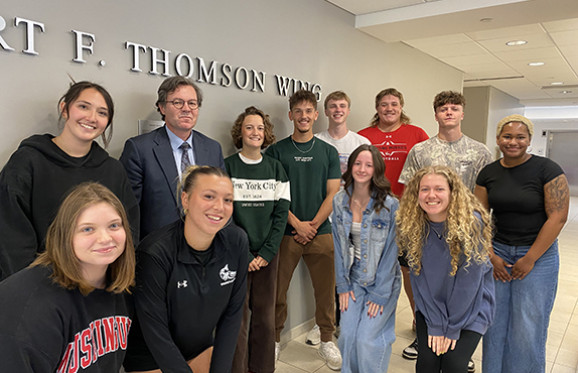
In my first months at Muskingum, several students have told me they found their calling here.
For some, it happened through the John and Annie Glenn Fellows experience; for others, through summer research alongside a faculty member or getting involved in leadership. What strikes me is that they aren't describing something they've learned. They're describing how an experience has changed what they believe is possible for their lives.
I don't think purpose necessarily arrives as a sudden revelation. More often, it takes shape through the things we do and the people we encounter.
We spend a great deal of time asking young people what they want to do when they grow up. It’s a fair question, and universities owe students a real answer. Families make enormous sacrifices to send their children to college, and they deserve more than vague promises about opportunity. But in our growing preoccupation with the economic value of college, I worry we’re neglecting the other question.
What do you want your life to be about?
I recently published a study with colleagues examining purpose and meaning among college students. Over the years we studied, the proportion reporting a strong sense of purpose and meaning declined considerably. I find that troubling. Purpose isn't some luxury we acquire once the practical business of life is settled. It's part of what helps us decide what that business is for.
I’ve come to think of purpose less as a destination than as a compass. It gives us direction without telling us precisely where we’ll end up, and it shifts as we encounter new experiences, people, and possibilities. A university cannot hand anyone a purpose. But it can create the conditions in which purpose grows by introducing us to ideas that unsettle our assumptions, people who challenge our thinking, and experiences that reveal abilities we didn't know we had.
Those conditions matter long after graduation. Today’s students may work for fifty years, in jobs that don’t yet exist, in an economy artificial intelligence is reshaping. We cannot prepare them for every change. But we can teach them to think, to question, to exercise judgment, to learn, unlearn, and learn again, to understand people whose lives differ from their own.
None of that is separate from preparing students for careers. It is preparation for a lifetime.
Yet I believe our responsibility goes further still. Personal fulfillment matters, but I'm not convinced we find it entirely on our own. Our lives are bound up with the lives of others. And perhaps our deepest sense of purpose comes when we recognize that our talents, our work, and even our everyday presence can make someone else's life a little better.
That’s what I hear when students tell me they’ve found their calling. They’ve begun to see not only who they might become, but what they might do for others.
Perhaps that is the fullest form of the other question. Not simply, What will this education do for me? But, What will I be able to do for others because of it?
It’s also, I believe, the answer to a question every university should ask of itself. For Muskingum, part of our purpose is helping people recognize possibilities in themselves they never imagined and preparing them to put those possibilities in service of others.
What we do here should matter far beyond here.
Flav Lilly
President, Muskingum University

