


In the News
Music and Your Mind’s Eye: An Art & Music Collaboration
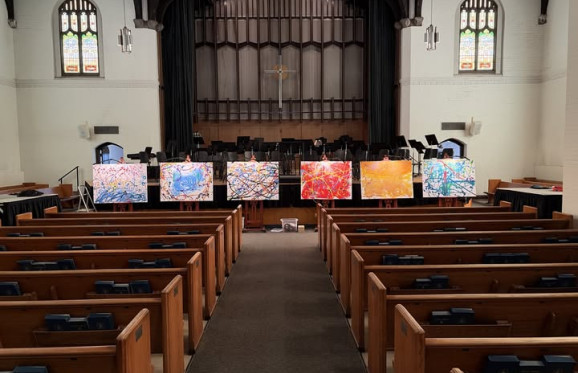
Music filled the air. Paint splattered across canvases. And with each new rhythm, a group of Muskingum University students had just minutes to turn what they heard into something they could see.
It wasn't a typical afternoon art class. Through a collaboration called Music for the Mind’s Eye, students explored the connection between visual art and music, creating six original abstract paintings inspired entirely by the sounds, rhythms, and emotions of musical selections chosen by Associate Professor of Music, Dr. David Turrill.
The idea grew from conversations between Turrill and Assistant Professor of Art, John Drubel, about finding a unique way to bring their disciplines together. Art and music share many of the same principles: rhythm, texture, contrast, unity, and variety, but the professors wanted to explore what happens when one art form directly influences another.
Their guiding question was simple. How does music affect creativity?
To find out, students gathered outdoors for an artistic experiment inspired by abstract expressionist Jackson Pollock, whose energetic painting techniques emphasized movement, spontaneity, and emotional expression. There were few rules. The artwork had to remain abstract, and students would receive no information about the musical compositions they were hearing. Instead, they were encouraged to let the music itself guide their decisions.
Each selection was played twice. During the first listening, students discussed what they heard, considering the mood, energy, and rhythms of the music. They quickly agreed on colors, techniques, and an overall direction for their painting. When the music began a second time, the painting started. And when the music stopped, so did they.
Dripping, pouring, smearing, splattering, and brushing paint across the canvases, students had only the length of each musical selection to complete their work.
"What was truly exciting about the collaborative work was the communication that had to happen between the students, and the level of engagement they had in the creative process," Drubel said. "Because there was no 'right' way to do it, and it had to be done quickly, the students were very unified in their approach."
The experience offered a different perspective on artistic training. While much of an art student's education focuses on developing technical skills, abstract expressionism encourages creativity through emotion, movement, and spontaneity.
"Students need to understand that creativity comes in all forms and that there are different methods for different goals," Drubel said. "My hope is that students view this as another tool in their toolbelt."
The creative energy extended beyond the participating art students. With music playing outdoors and paint flying across canvases, the activity attracted students and faculty from across campus. Turrill brought his Muskingum Experience class to observe and experiment, while Dr. Tom German's Visual Communication students created their own artwork, which will hang outside German's office.
What began as an interdisciplinary experiment became a shared campus experience, demonstrating how approachable and engaging art can be.
The collaboration came full circle on November 1, when the six paintings were presented during the Muskingum University Symphonic Winds concert, giving audience members an opportunity to experience the music through both sound and visual expression.
Turrill had carefully selected the musical repertoire to provide students with a wide range of tempos, styles, textures, and tonal qualities, hoping each piece would inspire strong visual imagery. But neither professor was looking for a particular artistic outcome.
"The goal is that there is not one 'right' visual interpretation of a piece of music, and that much of this is subjective," Turrill explained.
For Turrill, the relationship between music and visual storytelling is something audiences encounter more often than they may realize.
"Music can tell a story, whether there is a visual element or not, but it is often stronger when the two are connected," he said, comparing the experience to the way music enhances films and video games.
Following the concert, the paintings were slated for display in the University's gallery in conjunction with the Senior Art Show, extending the experience beyond the performance.
At its heart, Music for the Mind’s Eye was about more than creating paintings or performing music. It encouraged students to trust their instincts, work collaboratively, and explore the connections between artistic disciplines. And it invited audiences to consider something they may have experienced countless times without giving it much thought.
Music has always had the power to make us feel something. Through this collaboration, Muskingum students offered a glimpse of what those feelings might look like.
See the students in action as they create the artworks:

