


Alumni
Johnny Barba ’18 Finds His Way Home Through Medicine and Community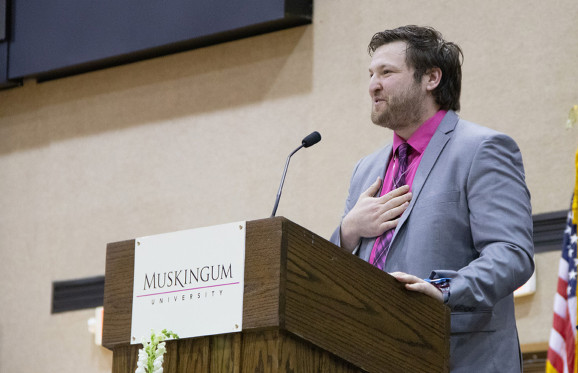
For Johnny Barba ’18, coming home isn’t an obligation. It’s simply where he belongs.
That idea has followed Barba from his childhood in Byesville, Ohio, to Muskingum, through medical school and public health training at The Ohio State University, and now into his dermatology residency. It was also at the heart of his return to Muskingum as the 2026 Opening Convocation speaker.
When people hear that Barba plans to practice medicine in Appalachian Ohio, he often gets the same reaction.
“People say, ‘It’s so honorable. You want to go back home,’” he said. “What do you mean it’s honorable? It’s home. Don’t you want to be at home?”
For Barba, home has always been defined as much by people as by place.
His father died two weeks before he was born, and Barba was raised by his mother and grandmother, surrounded by a network of aunts, uncles, extended family, friends and neighbors.
“I never felt that absence in my life because I was just so surrounded by love,” he said. “I haven’t called anybody Dad in life, but I’ve called a lot of people family.”
That community also helped make his education possible. An aunt bought his laptop when he started college. People in his community provided scholarships. Family members offered encouragement and support. Barba credits that network with making his education—and ultimately his career in medicine—possible.
Barba’s path to Muskingum wasn't direct. After taking college courses through Zane State while attending Meadowbrook High School, he received a full scholarship to Capital University. There, an early interest in biology, psychology and medicine developed into a fascination with neuroscience. When he learned Capital couldn't offer the neuroscience major he wanted, Barba made a decision that still makes him laugh.
“People change their majors in college,” he said. “I changed my college.”
The neuroscience program he was looking for turned out to be in his own backyard.
Even before his first day at Muskingum, Barba began communicating with faculty about what he hoped to accomplish. By the time he sat down with his advisor, Dr. Perera, he had read the academic requirements and mapped out his remaining three-and-a-half years.
Rather than being put off by his intensity, his new professors matched it.
“Day one felt like Muskingum to me because Dr. Perera just met me with that same enthusiasm and energy,” Barba said. “Even before I was at Muskingum, it started to feel like home. All these people knew my story. They knew my background.”
That relationship with Dr. Perera also produced one of his favorite Muskingum stories.
Barba once decided to drop a course and take it during a different semester. He brought the required form to Dr. Perera for her signature.
She refused. Then she shredded it in front of him.
“She said, ‘Absolutely not,’ threw it in the trash, and said, ‘Be better. You want me to push you? Be better.’”
Barba laughs when he tells the story, but he now recognizes it as exactly the kind of tough love he needed. It was also what he had asked of his Muskingum professors. He made a habit of telling faculty members to challenge him as though he intended to pursue their particular discipline professionally, a practice he continues today during his medical training.
That drive has taken Barba through undergraduate study, medical school, a Master of Public Health degree, and now residency. But one of his most enduring lessons came not from a professor or physician, but from his young cousin, Emmy.
During Barba's undergraduate years, Emmy came over wanting to play. Barba was studying and stressed about exams, and he wasn't particularly receptive.
His cousin noticed. She made him a drawing depicting Barba sitting at his desk and his stress looming over him.
“She said, ‘I need you to put your stress in time out and come outside and play with me.’”
Barba framed the drawing. Years later, it still hangs in his office.
His mother reinforced the same lesson, sometimes insisting that he step away from studying long enough to pick Emmy up from school. Finding balance remains a work in progress, Barba readily admits. But he's become more intentional about finding small pockets of time for the people who matter—calling a friend or family member while driving, for example, rather than allowing work to consume every available moment.
Barba's commitment to community has also shaped the way he thinks about medicine and public health.
While pursuing his MPH, he was walking through Cambridge City Park with his mother and Emmy and thinking about ways to create public health infrastructure in Appalachian communities. Emmy looked around the park and suggested it would be a good place for a disc golf course. Barba agreed that someone should make it happen.
Her response was simple: “Why wouldn’t you just do it?”
That conversation helped launch what became Barba's Dr. Disc Golf initiative, bringing together recreation, public health education and community partnerships.
The courses are designed so children, adults, and players with different ability levels can participate. Walking paths encourage physical activity, and tee pads include simple health messages. At events, participants may receive water, healthy snacks, sunscreen and health information.
But perhaps the most telling part of the project is how the courses themselves have been created. Businesses, nonprofits, public agencies, family members, and community volunteers have contributed whatever they could: funding, concrete, equipment, transportation, labor and materials. Rather than searching for a single organization to fund an entire project, Barba simply asked each partner what they could contribute.
One organization might provide equipment for a few hours. Another supplies concrete. Someone else finds a way to transport it.
“If you ever want to look for an example of teamwork, go to Appalachia and ask how people help one another,” Barba said. “People do more with less in Appalachia than anywhere in the world.”
It is an approach that sounds remarkably similar to what Barba remembers about serving on Muskingum's Student Senate. When student organizations requested funding for projects, he recalls that the conversation wasn't simply about approving or denying money. Instead, students asked how they could use their own experiences and connections to make one another's ideas better.
For Barba, community has never meant simply gathering people in the same place. It means recognizing what each person can contribute.
For all the accomplishments that appear on Barba's professional biography, he hopes his legacy is ultimately defined by much smaller things. He often returns to an idea attributed to Mother Teresa: “Do small things with great love.”
For Barba, one of those small things is learning someone's name. He keeps notes on his phone to help him remember the names of people he encounters in his residency—not just physicians or supervisors, but the people he works alongside every day.
He used to tell himself that he was bad with names. Eventually, he realized that wasn't a particularly good excuse.
“If you really want to learn somebody's name and be intentional about it, that's what you do,” he said. “People's names—that's the most sentimental part of a person. That's their name. That's what they know their whole entire life.”
It is a small gesture, but that's precisely the point.
Whether building a disc golf course one donated piece at a time, remembering the name of someone he sees at work, or preparing to bring his medical training back to the community that helped make it possible, Barba's approach remains remarkably consistent: start with what you have, recognize the people around you, and find a way to contribute.
Returning to Muskingum for Convocation gave him a chance to reflect on how far that philosophy has carried him. Afterward, Barba walked into Boyd Science Center and found the classroom where he once sat for organic chemistry. For a moment, the physician and dermatology resident could remember being the student who had arrived at Muskingum with three-and-a-half years of courses already mapped out but no way of knowing where those plans would ultimately lead.
“Nothing's guaranteed,” he said. “It's just so humbling to reflect back and take a moment.”
And, for a little while, to be home again.

