


In the News
Be More Than a Major: Students Bring Classroom Learning to Life Through Real-World Design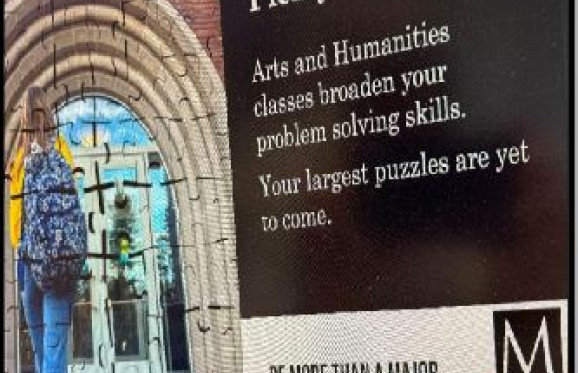
Last semester, students in Dr. Tom German’s Visual Communication class stepped beyond the traditional classroom and into a real-world creative partnership—one that challenged them to think not just like students, but like professional designers.
Partnering with Muskingum’s Arts and Humanities Division, the class was tasked with creating promotional messages for campus video displays and stand-up banners. The goal was clear: generate enthusiasm for humanities courses as both general education options and electives, while helping students across campus better understand the lasting value of learning outside their major.
What emerged was a unifying campaign theme—“Be More Than a Major.” The message resonated not only as a recruitment tool, but as a reflection of the broader Muskingum experience: that some of the most meaningful lessons come from unexpected places, and that exploring disciplines beyond one’s primary major can shape students for life.
For Dr. German, the project was about much more than completing an assignment.
“To simply assign a project and allow students to have the mentality that completion is the yardstick of success would do them a disservice,” he explains. “Working with a real client who hopes to put their work to use in the real world makes the rewards and consequences more tangible.”
Rather than designing for a grade alone, students had to listen, interpret, and translate. In Dr. German’s course, visual communication designers are taught to see themselves as intermediaries—bridging the gap between a client’s goals and an audience’s understanding. That process, he notes, is often far more complex than it appears.
“The ‘language’ a client uses to express their goals probably sounds nothing like what consumers would understand,” he says. “Designers have to fully understand those goals before they can create messages that truly resonate.”
Throughout the semester, students navigated that challenge—balancing creative instincts with client expectations, and learning firsthand how feedback shapes effective design. While a single semester isn’t enough to fully master the model, real-world projects like this often spark important realizations.
“I can always observe the ‘lightbulb’ moments,” Dr. German says, particularly when students present their work and hear direct feedback from the client. Those conversations—filled with both praise and constructive critique—help students see their work through a professional lens.
In recent semesters, Dr. German has also built reflection into the experience, giving students time to process what they learned while the client is still present. “It’s always a high note to end the semester like this,” he says.
The final designs—now visible across campus—stand as more than promotional materials. They represent collaboration, creativity, and Muskingum’s commitment to impactful learning that prepares students for life beyond graduation.

